Who Undocumented Migrants Are
Undocumented migrants are a diverse group of people, and there are many reasons for their undocumented status. A person may become undocumented, for example, if they remain in the country without a residence permit for one reason or another. From a healthcare perspective, those awaiting a family reunification decision are also considered undocumented. Even an EU citizen can be undocumented if they do not have health insurance in their home country (for example, the mobile population within Europe in some cases) or if the three-month time limit based on free movement is exceeded and they have not registered their stay thereafter. The status often changes over time, meaning it is not a permanent condition, and people themselves are not always aware that they are undocumented.
The Amount of Undocumented Migrants Keeps Growing
There are approximately 3,000–6,000 undocumented migrants in Finland, but the exact number is unknown. An estimated 90% of them reside in the capital region. Due to the government’s immigration policy reforms, the number of undocumented migrants is likely to increase in the near future. Undocumented migrants face several barriers when seeking health services, such as a lack of information about their rights, language barriers, ignorance of confidentiality obligations, mistrust of authorities stemming from past negative experiences, and racist attitudes among healthcare staff. The problem with undocumented migrants is underuse rather than overuse of services.
An accessible version of the graphical presentation above is available here.
Undocumented Migrants’ Access to Healthcare Varies From One Welfare County to Another
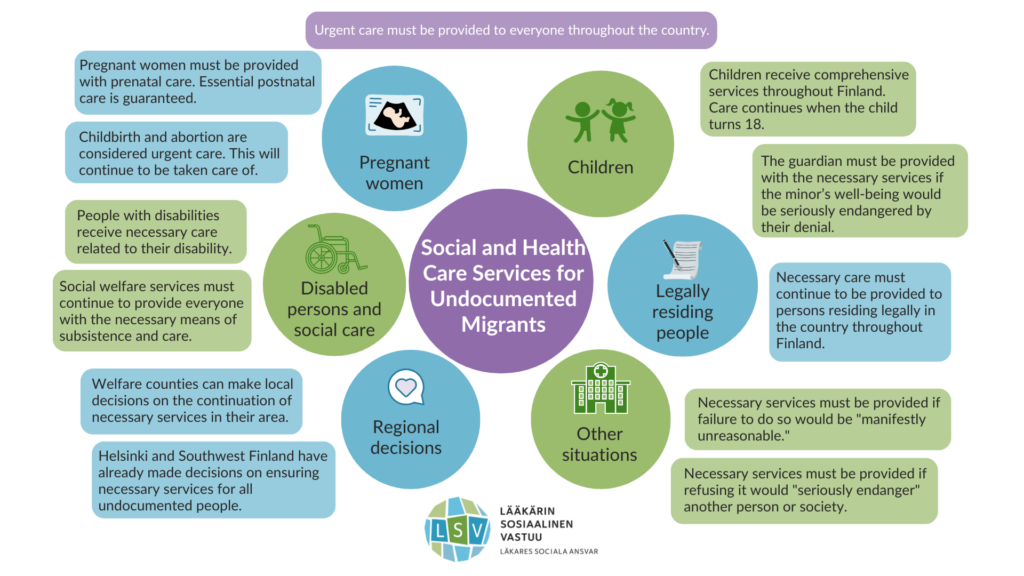
Undocumented migrants are entitled to emergency care throughout Finland. In many cases, they are also entitled to necessary care. In Finland, everyone is entitled to basic living support provided by social services. The right to care varies from one welfare region to another: Helsinki and Southwest Finland have made a local decision under which all undocumented migrants residing in the region receive necessary care.
What Does Necessary Care Include?
Necessary care includes at least the monitoring and treatment of chronic illnesses, vaccinations in accordance with the Communicable Diseases Act, prenatal care, as well as essential mental health services and essential dental care. It does not include treatment for conditions that do not worsen without treatment, such as fertility treatments, non-urgent health checkups, or the treatment of acne or mild osteoarthritis. Childbirth and abortion are considered urgent care and are provided to everyone.
The law on healthcare for undocumented individuals was tightened at the beginning of 2026, limiting healthcare services for those without a right of residence — with certain exceptions — to urgent care only. There are many exceptions, though. All welfare regions are required to provide at least necessary care, or more extensive care, in the following situations:
- People residing in the country legally continue to be provided with necessary health services throughout Finland.
- Children receive comprehensive services, meaning the same services as residents of the welfare region. Treatment for the same condition continues after the child turns 18.
- Necessary care must also be provided to the guardian of a minor if denying it would seriously jeopardize the minor’s well-being (for example, mental health services in some cases).
- Pregnant women receive necessary pregnancy-related care (including prenatal care) as well as care related to childbirth and postpartum care.
- People with disabilities receive necessary care related to their disability.
- Necessary care must be provided to everyone if denying it would be manifestly unreasonable.
- Necessary care must also be provided if denying it would seriously endanger another person or society (e.g., certain vaccinations).
The Need for Treatment Is Assessed on an Individual Basis
Each person’s situation is always assessed individually and on a case-by-case basis as part of the care needs assessment. A healthcare professional is responsible for conducting the assessment and determining whether the client should be provided with necessary care.
Customer Fee Invoice for a Person Without Funds
By law, undocumented migrants are generally required to pay the full cost of care. It is important to note that if a client is determined to be indigent, this must be recorded in the patient information system. In this case, the client will be sent an invoice only for the client fee, in the same way as for residents of the welfare area.